
Why wind noise grows so fast with speed
Aerodynamic noise rises much more steeply with speed than tire rolling noise. At city speeds wind hardly matters; on the highway it often becomes the loudest source. Overall cabin levels at 130 km/h (81 mph) are roughly between 65 and 75 dB(A) – yet a single whistle can still be annoying because it sticks out of the steady roar. Typical values by vehicle class are in the cabin noise comparison.
EVs: when the engine no longer masks it
Electric cars aren't generally louder. But without engine noise, wind and tire noise stand out much more. That's why wind noise, door seals and quiet tires are a constant topic in EV forums. Here especially, measuring across the whole speed range pays off: it shows from which speed it gets louder and whether a fix works.
Common causes
- Door seals: worn, shifted or damaged – or a door that isn't adjusted quite right.
- Windows: the glass doesn't close completely or the window guide is worn, especially with frameless doors.
- Side mirrors: mirror housing, gaps at the mirror base.
- A-pillar and windshield: loose trim or seals after a windshield replacement.
- Sunroof or panoramic roof: seals, wind deflectors.
- Roof rack, roof box, crossbars: classic whistle sources – try once without.
- Wipers, antenna, accessories such as window rain guards.
Wind or tires? How to separate the sources
- Surface test: drive the same speed on two different road surfaces. If the level changes clearly, it's more likely the tires.
- Direction test: drive the same route there and back. If it's clearly louder in one direction (headwind, crosswind), that points to wind noise.
- Speed curve: if the level rises especially steeply at the top of the speed range, wind is usually involved. The “noise by speed” table shows this directly.
More on tires in the tire noise test guide. If it hums rather than roars, see tire noise vs wheel bearing.
Narrowing it down: the tape test
A proven trick: temporarily cover suspicious gaps from the outside with painter's tape – for example the edge between door and frame, the mirror base or a trim strip. Then drive the same route at the same speed again and compare. If it's quieter, you've found the spot. Never tape over anything that affects visibility or safety, and remove the tape after the test.
Step by step with dB Ride
Record a baseline
Fixed route, phone in a mount, windows closed, ventilation off. Drive steady at e.g. 50, 60, 70 and 80 mph where legal and safe.
Change one thing
Roof rack off, gap taped, seal replaced – only one change per run.
Repeat
Same route, same speeds, similar wind if possible. Several runs per variant.
Compare
The comparison and “noise by speed” show whether the change helps mainly at high speed – typical for wind noise. The map also shows whether certain sections (bridges, gaps in tree lines, crosswind) stand out.
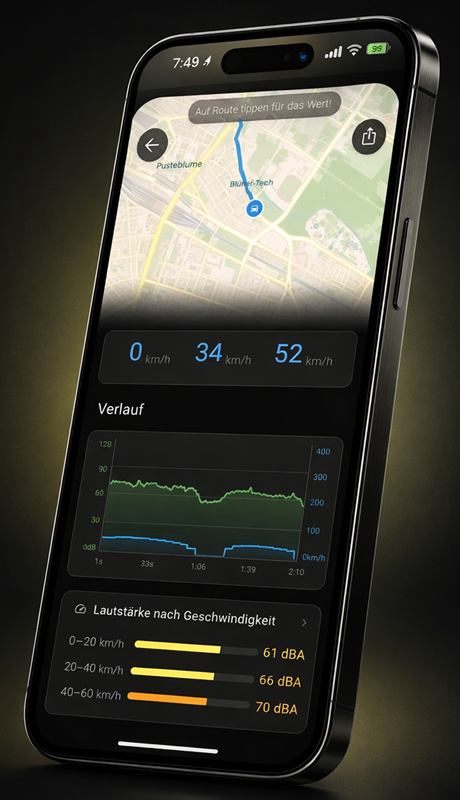
A phone microphone is not a calibrated sound level meter. Depending on the model, absolute readings can be off by several dB, and very high levels are not captured cleanly by every device. For before/after comparisons with the same phone in the same position, however, the results are very meaningful – that is exactly what dB Ride is built for. If you have a reference meter, you can set a calibration offset in the settings. More: how accurate is a phone decibel meter?
FAQ
Why does my car whistle above 60 mph?
Whistling usually comes from a gap or edge where air flows past at high speed: door seal, window glass, mirror base, roof rack. The tape test helps you find the spot.
Are electric cars louder than combustion cars?
Not generally. But because there's no engine noise, wind and tire noise stand out more. Overall levels at highway speed are in similar ranges.
Will a new door seal fix wind noise?
If the old one is worn or damaged, often yes. Measure before and after the replacement on the same route – then you know whether it was worth it.
How do I tell wind noise from tire noise?
Tire noise changes mainly with the road surface, wind noise with wind direction and speed. A surface test and a direction test at the same speed usually separate the sources well.
Measure it instead of guessing.
dB Ride is free for Android and iOS. Measuring, noise by speed, the map and comparing two recordings are free; Premium (one-time purchase, no subscription) removes ads and unlocks export and larger comparisons.
Sources & context
- Cabin noise range at 130 km/h: order of magnitude from interior noise measurements published by car magazines (e.g. auto motor und sport).
- Relationship between speed and aerodynamic noise: general fundamentals of vehicle acoustics.