
Cabin noise by vehicle class: typical ranges
How loud it gets inside depends mostly on speed, vehicle class, tires and road surface. The table shows rough guide values in dB(A) at about 70 mph, based on interior noise measurements published by car magazines. It doesn't replace a measurement: within one class, quiet and loud models are often several dB apart.
| Vehicle class | at ~70 mph | Typical |
|---|---|---|
| Luxury sedans and SUVs | approx. 60–65 dB(A) | lots of insulation, often acoustic glass |
| Midsize cars, SUVs, minivans | approx. 63–68 dB(A) | tires make a big difference |
| Compact cars | approx. 65–70 dB(A) | wind becomes dominant at highway speed |
| Subcompacts | approx. 67–72 dB(A) | less insulation, shorter gearing |
| Soft-top convertibles, off-roaders, vans | approx. 68–75 dB(A) | roof, frontal area, aggressive tires |
| EVs | similar to gas cars of the same class | no engine noise – wind and tires stand out more |
Between 60 and 80 mph the level usually rises by about 4 to 6 dB, mainly because wind noise grows faster with speed than tire noise. The guide on wind noise at high speed explains why and how to separate the sources.
Published test values from car magazines
Car magazines measure the cabin noise of individual models with professional sound level meters. Car and Driver records the level at a steady 70 mph in every instrumented test. These are the quietest vehicles from its list published in 2025, including several EVs:
| Vehicle (model year) | Level |
|---|---|
| Bentley Bentayga V-8 (2019) | 61 dB(A) |
| Rolls-Royce Cullinan (2019) | 62 dB(A) |
| Audi e-tron Sportback (2020, electric) | 63 dB(A) |
| BMW iX xDrive50 (2022, electric) | 63 dB(A) |
| Rolls-Royce Spectre (2024, electric) | 63 dB(A) |
| Ford F-150 Lariat PowerBoost (2021) | 64 dB(A) |
| Chevrolet Equinox EV 2LT AWD (2024, electric) | 65 dB(A) |
| Subaru Ascent Touring (2019) | 65 dB(A) |
| Honda Odyssey Elite (2025) | 66 dB(A) |
| Mazda CX-5 (2020) | 66 dB(A) |
| Buick Encore GX (2020) | 67 dB(A) |
Source: Car and Driver, “Bentley Bentayga, BMW iX Among the Quietest Cars We've Tested”, Caleb Miller, March 24, 2025 – version on Yahoo Autos. According to the article, measured with a Brüel & Kjær Class 1 sound level meter at a steady 70 mph, all vehicles on the same straightaway at the Chelsea Proving Grounds (Michigan). The microphone position in the cabin is not stated.
The German magazine AUTO BILD analysed more than 900 models tested between 2010 and 2012 at 50, 100, 130 and – where possible – 160 km/h. The 30 quietest cars measured 58 to 63 dB at 100 km/h (62 mph) and 62 to 71 dB at 130 km/h (81 mph); the quietest was a BMW 730d. The cars are old, but the order of magnitude is still useful.
Why values from different sources aren't directly comparable
A car with 64 dB in one test isn't necessarily louder than one with 63 dB in another. Car and Driver itself only uses runs from its Michigan straightaway for the list, because its smoother California track almost always produces lower readings. Differences come from:
- Microphone position: driver's head height, passenger side or rear seat.
- Road surface: coarse asphalt can matter more than the vehicle class.
- Tires: summer, all-season or winter, size and wear – see the tire noise test.
- Weather: headwind and wet roads raise the level noticeably.
- Analysis: average over a stretch or peak value, dB(A) or unweighted.
That's why the most meaningful comparison is one where you keep everything constant yourself.
How to measure your own car
Use the same road
A stretch with a uniform surface and little traffic where you can hold the speed legally and safely. Always the same road, ideally in both directions.
Windows up, ventilation off
Fan and radio off too, no talking. Dry road, as little wind as possible.
Phone fixed at passenger head height
In a mount or on the headrest, microphone uncovered. That's roughly where your ears are – and the same spot every time.
Select A-weighting
Choose dB(A) in the settings so your values are roughly comparable with published test figures. Switch the unit to mph if you prefer.
Hold a steady speed
Use cruise control. “Noise by speed” shows the average level per speed band – in mph mode in 12.5 mph steps, so 70 mph lands in the 62–75 mph row.
Compare several runs
At least three runs, then put them side by side. Comparing two recordings is free; Premium compares up to 8 and adds CSV and PDF export.
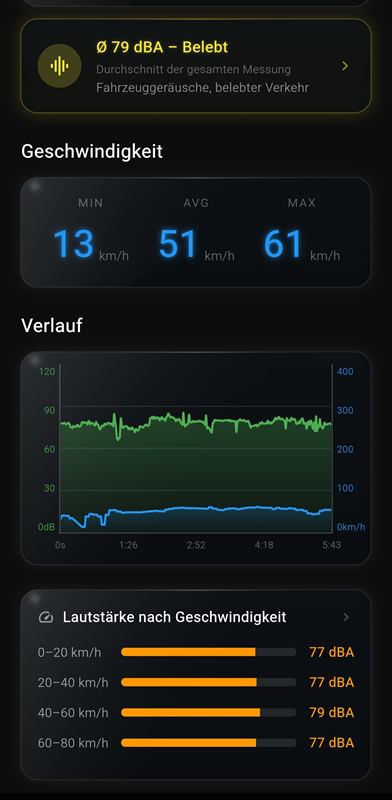
A phone microphone is not a calibrated sound level meter. Depending on the model, absolute readings can be off by several dB, and very high levels are not captured cleanly by every device. For before/after comparisons with the same phone in the same position, however, the results are very meaningful – that is exactly what dB Ride is built for. If you have a reference meter, you can set a calibration offset in the settings. More: how accurate is a phone decibel meter?
FAQ
How loud is a car at 70 mph inside?
Most cars land somewhere around 63–72 dB(A) at a steady 70 mph. Very quiet luxury vehicles go down to about 61 dB(A) in Car and Driver's tests; small cars, convertibles and off-roaders tend to be at the upper end.
Are EVs quieter inside?
At city speeds usually yes, because there is no engine noise. At highway speed wind and tires dominate, so EVs are similar to gas cars of their class – though several EVs rank among the quietest vehicles in Car and Driver's list.
Can I compare my reading with magazine test values?
Only roughly. Microphone position, road, tires and analysis differ. Comparisons with the same phone in the same position – for example before and after new tires – are far more meaningful.
Is 70 dB loud in a car?
70 dB(A) is typical for many cars at highway speed. It's tiring on long trips but not harmful to hearing. Every 3 dB more means double the sound energy – see the decibel chart.
How quiet is your car? Measure it.
dB Ride is free for Android and iOS. Measuring, noise by speed, the map and comparing two recordings are free; Premium (one-time purchase, no subscription) removes ads and unlocks export and comparisons of up to 8 recordings.
Sources & context
- Car and Driver, “Bentley Bentayga, BMW iX Among the Quietest Cars We've Tested”, Caleb Miller, March 24, 2025 – version on Yahoo Autos. Steady 70 mph, Class 1 sound level meter, Chelsea Proving Grounds (Michigan).
- AUTO BILD, “Ranking: Innengeräusche” (interior noise ranking, German), February 15, 2012 – autobild.de. Values in dB, weighting and microphone position not stated.
- Ranges by vehicle class: guide values derived from interior noise measurements published by car magazines; not measurements of individual models.
- Perception of level differences (1 / 3 / 10 dB): general acoustics fundamentals.