
Measure before you remove the first panel. You can't go back and take a “before” measurement later.
What sound deadening actually does
“Sound deadening” is used for three different things that fight different kinds of noise:
- Damping (butyl mats such as Dynamat, Kilmat, SilentCoat): the heavy viscoelastic layer calms vibrating sheet metal. It works mainly against drone, rattles and low-frequency hum – in doors, floor, wheel arches or trunk.
- Absorbing (foam, fleece): porous materials soak up sound in cavities, especially mid and high frequencies.
- Blocking (mass loaded vinyl, heavy barriers): a heavy, dense layer keeps airborne noise out. Tight door seals belong here as well.
So butyl alone makes a droning panel quieter but does little against wind roar at the A-pillar. Plan your measurement to match your goal.
Realistic expectations
So does sound deadening work? Usually it does – but there are no honest promises like “10 dB quieter” – the result depends on the vehicle, the areas you treat and the material. Many projects reduce the overall dB(A) level by only a few dB. That's not a failure: 3 dB less means half the sound energy. Often the character of the sound changes more than the number – less drone, a more solid door thud. That's why it pays to measure in dB(C) as well, which gives low frequencies more weight. To see where your car stands before you start, check the cabin noise comparison.
The measurement protocol
- Fixed test route with a uniform surface, in both directions.
- Fixed speeds on cruise control, e.g. 30, 60 and 75 mph.
- Same tires and tire pressure – never change tires between measurements. What tires do is covered in the tire noise guide.
- Dry weather, little wind, similar temperature.
- Windows closed, ventilation off or on a fixed setting, radio off.
- Phone in exactly the same spot, ideally near the driver's head height (e.g. a mount). Mark the position so you find it again after the work.
- Two weightings: runs in dB(A) for the overall impression, runs in dB(C) for drone.
- Stationary test as well: engine idling, windows closed – shows drone and vibration without wind.
- Several runs per variant, at least three.
Van builds and RVs
For a van conversion it makes sense to measure at two fixed positions: in the cab and in the living area. That way you see whether treatment in the back affects the level up front and how furniture, insulation and flooring change things. Same rule here: measure the empty van before the first mat goes on.
Step by step with dB Ride
Record “before” runs
Start recording while stopped, drive the test route, save as “Before – dBA – run 1”, and so on.
Do the deadening
Mark the phone position first, then get to work.
Record “after” runs
Same route, same speeds, same weighting.
Compare
The comparison shows a chart and the difference in dB. The “noise by speed” table shows whether the treatment helps more at low or high speed. With Premium you can compare up to 8 recordings – e.g. three before and three after runs.
Document
Use the PDF report (Premium) with chart and map for your build log or a forum post; the CSV raw data can be analysed further in Excel.
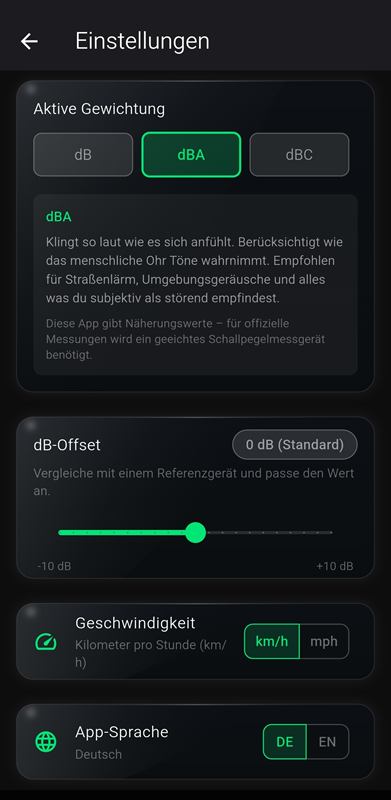
A phone microphone is not a calibrated sound level meter. Depending on the model, absolute readings can be off by several dB, and very high levels are not captured cleanly by every device. For before/after comparisons with the same phone in the same position, however, the results are very meaningful – that is exactly what dB Ride is built for. If you have a reference meter, you can set a calibration offset in the settings. More: how accurate is a phone decibel meter?
FAQ
Does butyl (Dynamat) alone make a difference?
Butyl mats calm vibrating panels and reduce drone and rattles. Against airborne noise such as wind or tire roar they help only to a limited extent on their own; you also need absorbers or a mass barrier. A before/after measurement shows what it does in your car.
How much quieter does sound deadening make a car?
That depends heavily on the vehicle and the scope. For the overall level, a few dB(A) is realistic – and 3 dB already means half the sound energy. Blanket promises aren't credible.
Should I measure in dB(A) or dB(C)?
Ideally both. dB(A) roughly matches what you hear; dB(C) shows low frequencies such as drone much more strongly, which often play the main role in deadening projects.
Where should I put the phone?
Fixed and repeatable, ideally near the driver's head height, for example in a mount. Don't cover the microphone. What matters most is that the position is identical for all measurements.
Measure it instead of guessing.
dB Ride is free for Android and iOS. Measuring, noise by speed, the map and comparing two recordings are free; Premium (one-time purchase, no subscription) removes ads and unlocks export and larger comparisons.
Sources & context
- Principles of damping, absorption and blocking: general fundamentals of technical acoustics.
- Level addition and perception (3 dB = double sound energy): general acoustics fundamentals.