
Why tires matter so much
In modern cars, tire/road noise is usually louder than the powertrain even at moderate speeds. At highway speed wind joins in, but much of the low roar and hum you hear on a country road comes from the tires. That's why two sets of tires can sound very different: tread pattern, rubber compound, width, sidewall height and wear all play a part.
Winter tires are often a bit louder than summer tires because of their coarser tread and many sipes – but not always. Two summer tires of the same size can also differ audibly. And a worn tire with uneven wear (cupping, feathering) can roll considerably louder than the same tire when new.
What the EU tire label tells you – and what it doesn't
The EU tire label shows the external rolling noise in dB plus a class from A to C (Regulation (EU) 2020/740). It is measured outside the vehicle in a standardised pass-by test. That's a useful indication, but it doesn't directly tell you how loud it will be inside your car: how much noise reaches the cabin also depends on how the tire interacts with suspension and body, which frequencies it produces and how well your car is insulated. That's why your own measurement is worth it.
How to measure properly
The key rule: change only one thing – the tires. Everything else must be as identical as possible for both measurements.
- Same road, same surface. The road surface can matter more than the tire change. Coarse asphalt, concrete slabs and low-noise asphalt sound completely different. Pick a stretch with a uniform surface and drive it every time.
- Same speed. Use cruise control and measure at constant speeds, e.g. 30, 60 and 75 mph (50, 100, 120 km/h).
- Phone fixed in the same position. In a mount or wedged in the center console, never in your hand. Don't cover the microphone.
- Windows closed, ventilation off (or on exactly the same setting), radio off, no talking.
- Dry road. A wet road is much louder. Strong wind also skews results.
- Same tire pressure as specified by the manufacturer, same load.
- Break in new tires. Drive freshly mounted tires a few hundred miles before your final measurement.
- Several runs. At least three per tire set, ideally in both directions, then compare the averages.
Step by step with dB Ride
Choose a test route
A stretch of road with a uniform surface and little traffic where you can hold the target speed.
Mount the phone, select dB(A)
Activate A-weighting in the settings. If low hum is what bothers you, add runs in dB(C). Switch the unit to mph if you prefer.
Start before you drive off
Start recording while stopped, drive at a steady speed. When saving, use a clear name such as “Summer tires – run 1”.
Repeat after the tire change
Same road, same speeds, same conditions – again several runs.
Compare
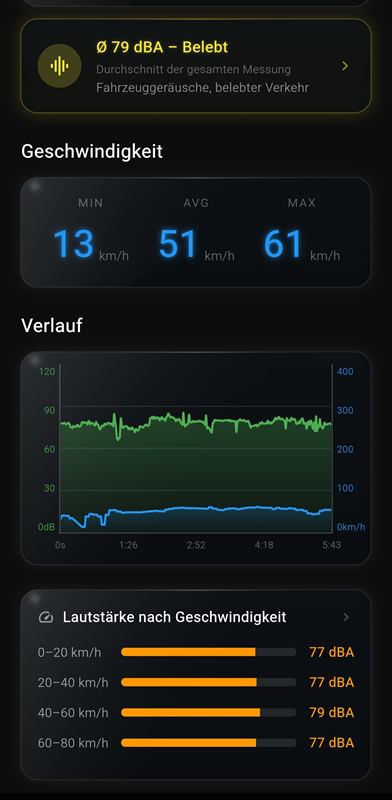
Select the recordings in the overview and compare them. The key is the “noise by speed” table: it shows in which speed range the new tire is quieter or louder. With Premium you can compare up to 8 runs and export everything as CSV or PDF.
Reading the results
A difference of 1 dB is barely noticeable in everyday life. From about 3 dB – double the sound energy – you clearly hear it; 10 dB more is perceived as roughly twice as loud. If your runs already vary by 2 dB among themselves, a 1 dB difference between tire sets isn't reliable. More runs or a quieter test route help.
If one tire is louder mainly in a particular speed range, resonance may be the cause. If it simply gets louder with every mph, it's usually just more rolling noise. The speed breakdown also helps with telling wind noise from tire noise. To see where your car stands against others, check the cabin noise comparison.
A phone microphone is not a calibrated sound level meter. Depending on the model, absolute readings can be off by several dB, and very high levels are not captured cleanly by every device. For before/after comparisons with the same phone in the same position, however, the results are very meaningful – that is exactly what dB Ride is built for. If you have a reference meter, you can set a calibration offset in the settings. More: how accurate is a phone decibel meter?
FAQ
Are winter tires louder than summer tires?
Often yes, because the coarser tread with many sipes produces more noise. But there are quiet winter tires and loud summer tires – only a direct comparison on the same road tells you for sure.
How many dB difference between tires is realistic?
Inside the car, differences between two similar tires are often just a few dB. That sounds small but matters: 3 dB already means double the sound energy and is clearly audible.
Tires or wheel bearing – how do I tell?
Tire noise changes a lot with the road surface. A failing wheel bearing usually hums depending on speed and often changes in corners as the bearing is loaded or unloaded. Recording “noise by speed” helps document it – but leave the diagnosis to a mechanic. More: tire noise vs wheel bearing.
Can I verify the tire label value with the app?
No. The label value is measured outside the car in a standardised pass-by test. dB Ride measures what reaches you inside your car – usually the more interesting number for you.
Measure it instead of guessing.
dB Ride is free for Android and iOS. Measuring, noise by speed, the map and comparing two recordings are free; Premium (one-time purchase, no subscription) removes ads and unlocks export and larger comparisons.
Sources & context
- Regulation (EU) 2020/740 on the labelling of tyres (EU tire label) – eur-lex.europa.eu
- Cabin noise ranges: order of magnitude from interior noise measurements published by car magazines (e.g. auto motor und sport); individual vehicles can be above or below.
- Perception of level differences (1 / 3 / 10 dB): general acoustics fundamentals.