
Decibels in a nutshell
The decibel scale is logarithmic. +3 dB means double the sound energy, +10 dB ten times as much – and is perceived as roughly twice as loud. A 1 dB difference is barely audible, 3 dB is clearly noticeable. Most values in this chart are in dB(A), i.e. adjusted to human hearing.
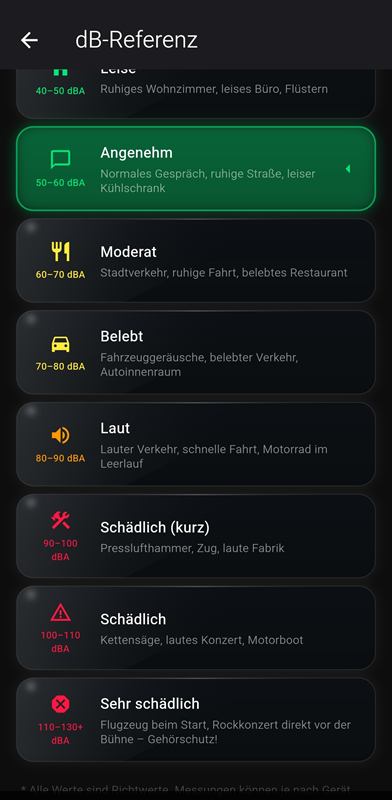
Decibel chart with everyday examples
| Level | Examples | Assessment |
|---|---|---|
| 0 dB(A) | threshold of hearing | just audible |
| 30 dB(A) | whisper, quiet bedroom at night | very quiet |
| 40 dB(A) | quiet apartment, library | quiet |
| 50 dB(A) | quiet office, soft conversation, rain | calm |
| 60 dB(A) | normal conversation, TV at room volume | moderate |
| 70 dB(A) | vacuum cleaner, busy street, car cabin at country-road speed | loud, tiring over time |
| 80 dB(A) | heavy traffic nearby, blender | very loud – lower action value at work (8 h) |
| 85 dB(A) | very heavy traffic, gas lawn mower, under a motorcycle helmet at country-road speed | upper action value (8 h): hearing protection required at work |
| 100 dB(A) | jackhammer nearby, nightclub | hearing damage possible after a short time |
| 110 dB(A) | rock concert in front of the stage, chainsaw | extremely loud |
| 120 dB(A) | siren at close range, jet taking off nearby | threshold of pain |
How loud is it in a car and on a motorcycle?
| Situation | Typical range | Depends on |
|---|---|---|
| Car cabin at 100 km/h (62 mph) | roughly 60–70 dB(A) | vehicle class, tires, road surface, insulation |
| Car cabin at 130 km/h (81 mph) | roughly 65–75 dB(A) | quiet luxury cars at the lower end, small cars, convertibles or off-roaders higher |
| Under a motorcycle helmet at 100 km/h (62 mph) | approx. 84–95 dB(A) | helmet, fit, windscreen, bike, riding position |
Ranges by vehicle class and published test values are in the cabin noise comparison. How to measure these values in your own vehicle is explained in the guides on tires, sound deadening, wind noise and motorcycle helmets.
How long is how loud still okay?
For your hearing, duration matters as much as level. A widely used rule of thumb is based on the equal-energy principle: starting from 85 dB(A) for 8 hours, the comparable time halves with every 3 dB more.
| Level | Comparable duration |
|---|---|
| 85 dB(A) | 8 hours |
| 88 dB(A) | 4 hours |
| 91 dB(A) | 2 hours |
| 94 dB(A) | 1 hour |
| 97 dB(A) | 30 minutes |
| 100 dB(A) | 15 minutes |
dB, dB(A) and dB(C) – what's the difference?
- dB (Z or unweighted): all frequencies weighted equally.
- dB(A): mimics human hearing at moderate levels – low and very high tones count less. The standard for traffic, environmental and workplace noise.
- dB(C): almost flat, low frequencies count much more. Good for drone, bass and loud levels.
If dB(C) is clearly higher than dB(A), the noise contains a lot of low-frequency sound – in a car often a sign of drone.
A phone microphone is not a calibrated sound level meter. Depending on the model, absolute readings can be off by several dB, and very high levels are not captured cleanly by every device. For before/after comparisons with the same phone in the same position, however, the results are very meaningful – that is exactly what dB Ride is built for. If you have a reference meter, you can set a calibration offset in the settings. More: how accurate is a phone decibel meter?
FAQ
How loud is 70 dB?
About as loud as a vacuum cleaner or a busy street. Many cars are in this range at country-road speed. Tiring over time, but not harmful to your hearing.
Is 85 dB dangerous?
85 dB(A) over a full working day is the level at which hearing protection becomes mandatory at work in the EU, and NIOSH's recommended limit. Short exposure is not critical, but the louder it gets, the shorter the acceptable time.
What does dB(A) mean?
dB(A) is a sound level with A-weighting: it weights frequencies roughly the way the ear perceives them. That's why dB(A) is the standard for traffic and environmental noise.
How loud is a car at 80 mph?
Roughly between 65 and 75 dB(A) at 130 km/h (81 mph), depending on car, tires and road surface. With dB Ride you can measure where your car sits – and at which speed it gets louder.
Measure it instead of guessing.
dB Ride is free for Android and iOS. Measuring, noise by speed, the map and comparing two recordings are free; Premium (one-time purchase, no subscription) removes ads and unlocks export and larger comparisons.
Sources & context
- Directive 2003/10/EC (noise at work), exposure action values – eur-lex.europa.eu
- NIOSH, Criteria for a Recommended Standard: Occupational Noise Exposure (1998) – 85 dB(A), 3-dB exchange rate.
- ADAC (German automobile club), motorcycle helmet tests: approx. 84–95 dB(A) at 100 km/h.
- Car cabin noise: order of magnitude from tests published by car magazines (e.g. auto motor und sport).
- Everyday examples: common reference values, e.g. from the German Environment Agency (Umweltbundesamt).