
How loud is it under a helmet?
In helmet tests by ADAC, Germany's largest automobile club, the levels measured at 100 km/h (62 mph) ranged roughly from 84 to 95 dB(A) depending on the helmet. Wind noise rises steeply with speed, so on the highway it gets even louder. For comparison: EU workplace rules treat a daily noise exposure of 85 dB(A) as the upper action value at which hearing protection must be worn. That value refers to a full working day – but it shows the order of magnitude. Helmets don't come with a standardised noise label, so independent tests like ADAC's are the main source of decibel ratings.
Because the scale is logarithmic, every dB counts: following the equal-energy principle, each additional 3 dB halves the time considered comparably harmful. A long ride at high levels can quickly add up to more noise than a full shift in a loud factory. Noise-induced hearing loss develops gradually and can't be cured; tinnitus is a common warning sign.
What affects the noise under your helmet
- Helmet and fit: a helmet that's too big or gaps around the neck and chin let turbulence in. Cheek pads, chin curtain and neck roll make a big difference.
- Visor and vents: the visor seal, open vents and add-ons whistle or roar.
- Windscreen: a screen can calm the airflow – or, at the wrong height, send turbulence right at your helmet.
- Bike and riding position: naked bike, tourer, sport bike and your height change the airflow completely.
- Clothing: a neck tube or windproof collar damps noise from below.
- Speed: the biggest factor. The “noise by speed” curve shows you when it gets critical.
That's why many riders wear hearing protection, such as foam earplugs or custom-molded plugs. Make sure you can still hear traffic and signals, and check the rules in your country.
Measuring it yourself – the right way
Honesty matters here: where the microphone sits determines what you measure. A phone in a handlebar mount or tank bag measures the noise at that spot – not at your ear. That's fine for comparing things that change the airflow overall, such as windscreen up vs. down, bike A vs. bike B or different speeds.
For a true helmet-vs-helmet comparison the microphone has to be inside the helmet, as close to your ear as possible. A phone doesn't belong there. One option is a wired headset microphone inside the helmet, if your phone uses it as its input – check this while stationary by talking into the headset and watching whether the level reacts. Also note: not every phone microphone captures very high levels around 90 dB and above cleanly. Relative comparisons remain useful, but read absolute values with caution.
Step by step with dB Ride
Fix the microphone position
Mount, tank bag or headset in the helmet – and keep it exactly the same for every run.
Turn on spoken readouts
The app reads out the values, e.g. through your intercom. You don't need to look at the screen while riding.
Start while stopped
Start recording, gloves on, ride off. Only operate the phone when stopped.
Ride at constant speeds
A road where you can safely hold e.g. 50, 60 and 75 mph, ideally with little crosswind.
Change one thing and repeat
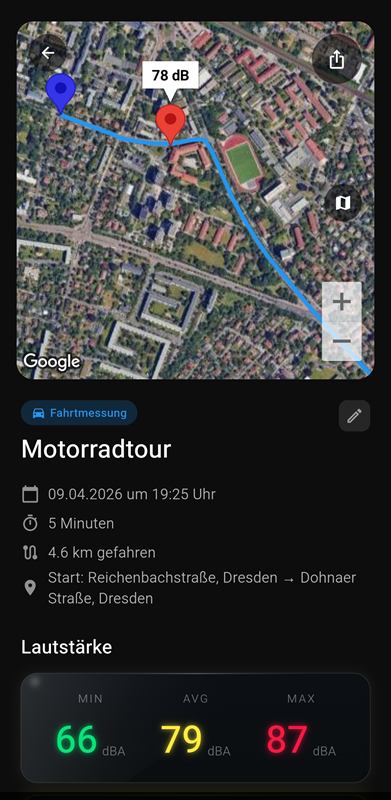
Adjust the screen, swap the helmet, close the vents – one change at a time. Then compare the runs side by side; “noise by speed” shows the differences per speed range.
For an overview of how loud 85, 100 or 120 dB are in everyday life, see the decibel chart.
A phone microphone is not a calibrated sound level meter. Depending on the model, absolute readings can be off by several dB, and very high levels are not captured cleanly by every device. For before/after comparisons with the same phone in the same position, however, the results are very meaningful – that is exactly what dB Ride is built for. If you have a reference meter, you can set a calibration offset in the settings. More: how accurate is a phone decibel meter?
FAQ
How loud is it under a motorcycle helmet?
In ADAC helmet tests the levels at 100 km/h (62 mph) ranged roughly from 84 to 95 dB(A) depending on the helmet. At higher speeds it gets considerably louder because wind noise rises steeply with speed.
When does noise damage your hearing?
EU workplace rules use 80 and 85 dB(A) as action values, based on an 8-hour day; NIOSH recommends 85 dB(A) over 8 hours. With every 3 dB more, the comparable time halves. At helmet noise levels, that limit is reached quickly on longer rides – so hearing protection is a good idea.
Which motorcycle helmet is the quietest?
It depends heavily on fit, bike and riding position – a helmet that was quiet in a test can be louder on your bike. Helmet tests give guidance; your own measurement shows how it is for you.
Can I measure inside the helmet with my phone?
The phone itself doesn't belong in the helmet. For helmet comparisons, a wired headset microphone inside the helmet works if your phone uses it as its input. With the phone in a mount you can compare windscreen, bike or speed well.
Measure it instead of guessing.
dB Ride is free for Android and iOS. Measuring, noise by speed, the map and comparing two recordings are free; Premium (one-time purchase, no subscription) removes ads and unlocks export and larger comparisons.
Sources & context
- ADAC (German automobile club), motorcycle helmet tests with noise measurement at 100 km/h: range approx. 84–95 dB(A) depending on the helmet.
- Directive 2003/10/EC (noise at work), exposure action values 80 / 85 dB(A) – eur-lex.europa.eu
- NIOSH, Criteria for a Recommended Standard: Occupational Noise Exposure (1998) – 85 dB(A), 3-dB exchange rate.
- Note: this guide is not medical advice.